Thursday, May 30, 2013

Today is my last day in England... I only had 8 full days in England and yet I managed to travel 1,415 miles within the country. If I were to include the flight miles the total would be 8,319 miles. I can honestly say that this has been the most interesting, informative, and fun trip I have gone on. Not to mention that is was school related! I am really glad I choose this topic. I understand why some of my peers decided to do more laid back projects, because after a year of hard work we kind of deserve it. I am not putting down their projects, I would have loved to take pictures of puppies or cooked Greek food, it's just that I love history and I love England. This trip allowed me to combine these interests while visiting family, taking fun road trips, and learning to surf. Looking back I did a lot in 8 days.

I was surprised at what I learned from this trip. The main purpose was to discover if King Richard III was actually the villain Shakespeare made him out to be. I did investigate this question but I also learned other things along the way. I learned that my irrational fear of writing stemmed from the restrictions of writing in school. In my opinion this blog is just as informative as any paper I have written at Williams. The difference is that I was allowed to set my own guidelines. I could make it as informal and funny as I wanted and I could included pictures. While writing I knew that no teacher would be grading my words and anyone who wanted to read it could and those who didn't care for the topic could choose not to read it. I doubt many people will come to my Senior Project presentation because I admit my enthusiasm for the English monarchy is strange and that most people fall asleep in History Class when the topic comes up. But you know what? I don't care. I love history and this project gave me the opportunity to explore a subject that I love in depth and I had a blast.

Another thing I learned is that when you reach out to people (like the Visits Officer I contacted to find out more about the exhibit in Leicester) they are more willing to accommodate you because you showed interest. I would not have known about all the places to visit if I have not put aside my fear of reaching out to a professional and asking for help. A bonus to this is that I am only 18. The adults I have talked to about the project are surprised and impressed by the fact that I picked an academic project when I could have done something more relaxing. As long as you show interest people will always be willing to help an this is a very important lesson for my future. 

Wednesday, May 29, 2013


Here is the third and final road trip. The driving was awful because of pouring rain and traffic. It took much longer than the projected 1 hour and 53 minutes to get there. That said, it was totally worth it. 


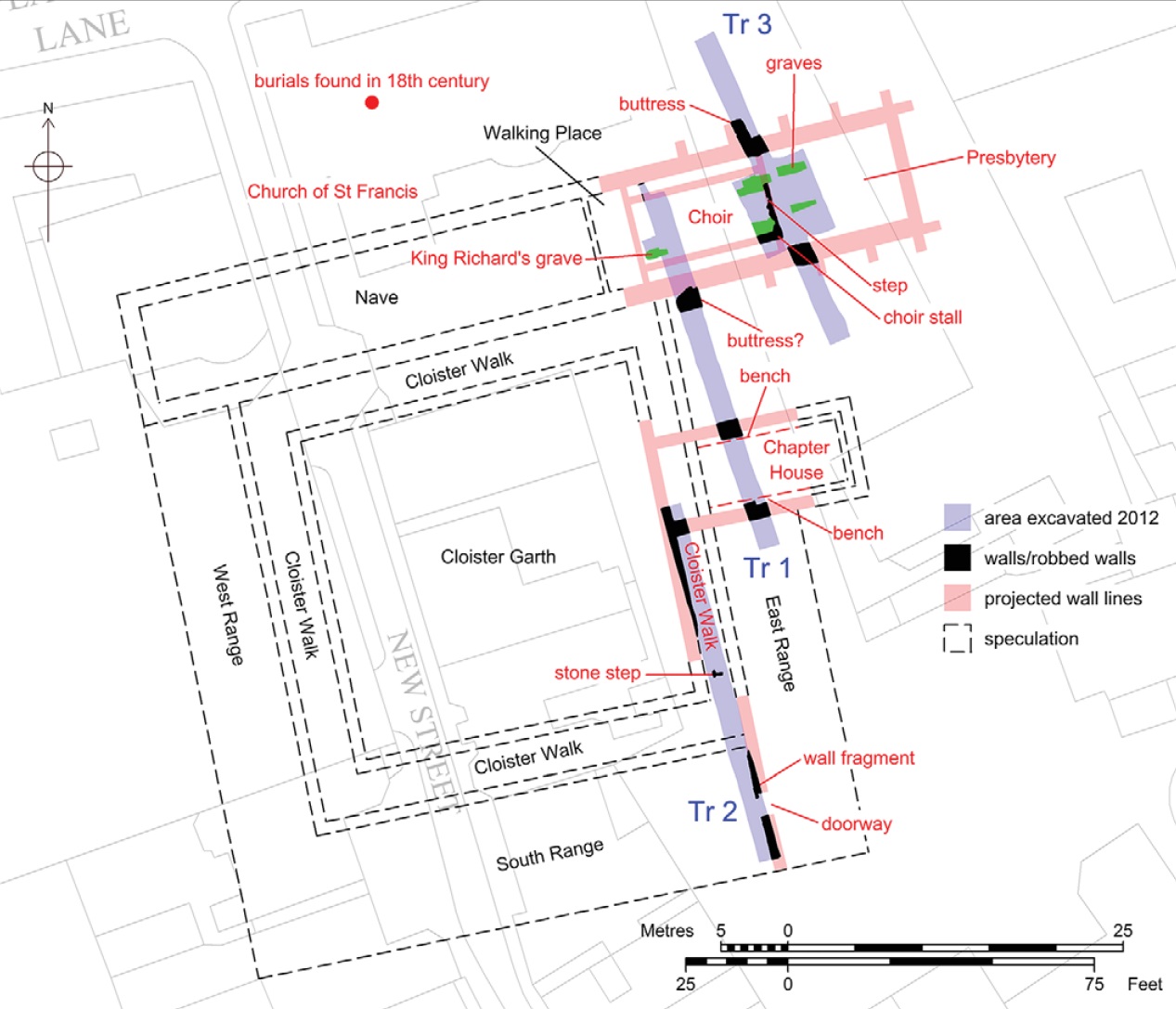
I did not get to see the actual skeleton but here is a picture of how the body was discovered. As you can see the upper part of the body looks squished, as if the grave was not long enough to lay him out flat. Another theory is that the location where the body was buried, the choir of the Greyfriar's church, was a very small space that was not usually used for graves. I have also added in a blueprint for the  church. It shows the small size of the choir and also how lucky the researchers were that they stumbled upon Richard's remains in one of the three trenches they dug out. Considering the amount of building activity that went on in the past 300 or so years in Leicester it is surprising that the skeleton remained as intact as it did, with only the feet missing. I wish we could have had more time in the city or that I had scheduled a guided tour of the dig but I am happy with what I was able to accomplish in about 2 hours.  


Here I am with Richard's reconstructed head. Scientists used his skull and were able to add the complex system of muscles and skin tissue using a computer program. From the computer model artists used wax and other realistic materials to show Richard's face for what it truly was. He was only 32 at the time of his death and unlike the doctored portraits of the Tudor era Richard's reconstructed face shows him to look much healthier, younger, and almost handsome. The reconstructed face is on a nation wide tour so I was really lucky to happen to be in Leicester when it was visiting the city. 

Tuesday, May 28, 2013


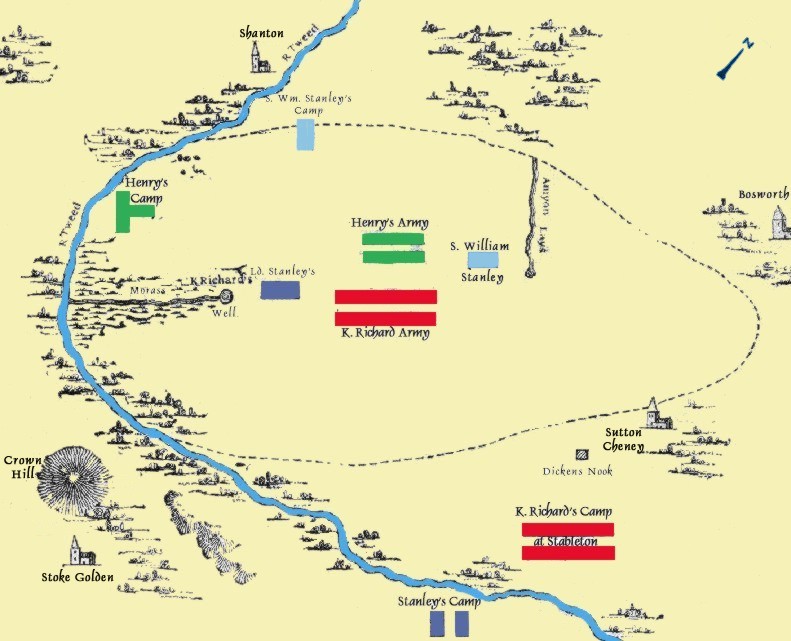
August 22, 1485 was a decisive day in the history of England. The day saw two kings of England and the closing and starting of new eras. The day started with the last Plantagenet King of England and ended with the first Tudor one. Richard III's death is generally regarded as the end of Medieval England and Henry VII's reign is considered the start of the Renaissance. Let's see how this momentous battle went down.  Here is a supposed map of the Battle of Bosworth Field. Richard's Army is red and Henry's army is green. As you can see from the size of the armies drawn Richard should have had the advantage from the start. Richard did until he was betrayed by the Duke of Northumberland who refused to fight for his king and Lord Stanley who did not pick a side until he was sure that Henry was going to win. These betrayals were Richard's downfall and although he fought valiantly he became the last English King to be killed in battle. Richard was killed by Welsh pike men and his naked body was carried by horseback to the Greyfriars Church in Leicester where he was put on display for three days. He was then buried in the church choir and 10 years later Henry VII paid for a marble tomb for the King he had killed. Sadly this tomb was destroyed during the dissolution of the Catholic monasteries under Henry VII's son Henry VIII. 

His skeleton had 10 wounds and the wounds suggested that he lost his helmet during battle. He had numerous Portsmouth injuries known as "insult injuries". These were most likely inflicted by victorious knights who wanted to mock and humiliate their dead enemy as his body passed by on the way to town. They made sure to not do too much damage to his face though because Henry Tudor wanted the body to be recognizable so he could prove that Richard III was dead and that he was now King Henry VII. 


Unfortunately we did not make it to Bosworth Field. It was pouring rain and our day trip to Leicester was in danger because of all of the traffic and it was no small feet that we managed to get home at a reasonable hour. We did visit the location where the body was discovered last year. Pretty cool parking lot, eh? We weren't allowed to go any farther and I really wish I had called ahead to arrange a private tour of the dig. Although, the weather was so awful it might not have been worth it. The exhibit on Richard and the discovery of his body was fascinating. There was an interactive skeleton that displayed and explained the various markings on the body and showed that while Richard had scoliosis  the basis of which Shakespeare based his dis formed hunchback, it only raised his right should slightly and did not affect his fighting ability. The most interesting feeture of the discovery of the remains was that the skeleton did not have feet. Researchers believe that the various buildings that were built on the site in the years to follow disturbed the body and the feet were somehow lost. Scientists were able to prove that the skeleton they found under the parking lot was actually Richard III through DNA testing. Although Richard has no living decedents his sister Anne of York does and the DNA is a perfect match. Using his skull and advanced computer technology scientist were are able to reconstruct Richard's face. I will post a picture of me with the reconstructed head and a more detailed description of the process in a later post. 

Sunday, May 26, 2013


In the summer of 1483 the 12 year old uncrowned king of England Edward V and his 9 year old brother Richard vanished. They were last seen in the Tower of London and the common theory is that they were murdered by their blood lusting and ambitious uncle Richard III. They were not the first English princes with a claim to the throne to vanish mysteriously. When Richard I died he did not have a legitimate heir. He named his nephew Arthur, Duke of Brittany, as heir to the kingdom. Richard's brother John took the throne and after putting down a rebellion led by Arthur the recently turned 16 year old prince disappeared. 
 
The Princes in the Tower, as they came to be known, were declared illegitimate by Parliament because their father Edward IV had already had a betrothal contract with another woman when he married their mother. Richard III, then Duke of Gloucester, was Protector of the Realm for his underage nephew. Parliament offered Richard the throne after his nephews were disinherited and after pretending to be reluctant he accepted. That's all good but what happened? There wasn't any proof at the time that Richard murdered his nephews. That accusation came to light in Shakespeare's Richard III. Now why would Shakespeare talk trash about Richard when he had praised other kings in his plays? It was all about money and endorsement  . Shakespeare rose to prominence during the reign of the fifth Tudor monarch, Elizabeth I. Her grandfather Henry VII, the victor at Bosworth Fields, had done everything in his power to ruin Richard's reputation. Richard only ruled for two years and two months and yet the propaganda under the Tudors destroyed the image of a king who actually accomplished a lot it such a short amount of time. A few months after his coronation Richard created the Court of Requests, a court designed for poor people who could not afford to pay to be represented. He introduced the concept of bail into the English court system to protect the accused   and in 1484 created the College of Arms, a complex organization that to this day grants new coat of arms, genealogy research and recording of pedigrees. To finish off the list he banned restrictions on the printing and sale of books, ordered the translation of the written Laws and Statutes from the traditional French into English, and put down a full fledged rebellion in 1483. 

Not too shabby, eh? Richard III did a relatively good job as king compared to a few of England's monarch before and since. For example Richard I spent the entirety of the English treasury funding a mercenary army  to fight his hated enemy the French, to fight in the Holy Land, John lost all of England's possessions in France, Edward II lost his kingdom to his wife and her lover because he refused to give up his male favorites and was not brave enough to take action, poor Henry VI went through periods of madness and walked around in bed clothes, Henry VIII had six wives and murdered two of them, Bloody Mary  tried to force Catholicism on newly Protestant England and burned hundreds at the stake, Charles I lost his kingdom (and his head) because he decided to rule without ever calling a Parliament into order, as King of Great Britain George I could not speak English, George III lost the entire American colonies and went completely mad, Edward VIII gave up the throne so he could marry a divorced American woman.... the list goes on and on! Every single on other these monarchs ruled longer than Richard and yet Richard III is easily the most hated. I will continue to investigate this in my next post by looking through paintings and Tudor propaganda for the lies told about Richard.

Saturday, May 25, 2013


Here is the second road trip. We started out on Friday afternoon from Weybridge (A) and spent the night in Wincanton (B). The next day we left at 7 AM and thanks to traffic we did not make it to St. Ives (C) until 11:30 AM. On the way back we drove down to Land's End (about 30 minutes from St. Ives) and then did the entire 267 miles in one go.